
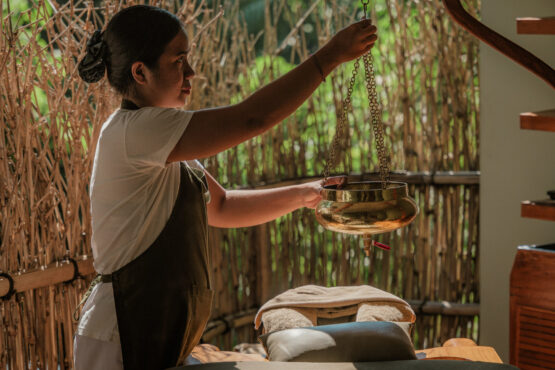
What is Ayurveda
Ayurveda is an ancient tradition of wisdom, a holistic healing art and life philosophy that has been practiced in India for over 6,000 years.
A holistic view of the human being
It is one of the world's oldest medical systems, with roots stretching deep into the Vedic scriptures – the same spiritual source from which yoga, meditation, mantra, and Vedanta have sprung. The word Ayurveda literally means “knowledge of life” (ayur = life, veda = knowledge), and Ayurveda sees all of life as an interplay between body, mind, soul, and the surrounding world.
Ayurveda does not consider humans as an isolated body, but as a living expression of the universe's elements – earth, water, fire, air, and ether. These elements combine to form the three fundamental life energies, or doshas: Vata, Pitta, and Kapha.
- Vata represents movement, air, and ether – it governs the nervous system, breathing, circulation, and creativity.
- Pitta is fire and water – it governs digestion, metabolism, intelligence and passion.
- Kapha consists of earth and water – it represents stability, nourishment, the immune system, and emotional security.
Every human is born with a unique combination of these doshas, which is called prakriti – your innate constitution. When the doshas are in balance, we feel well, but when they become unbalanced, ill health arises, both physically, mentally and
Sound, vibration and subtle forces
Ayurveda also recognises the subtle layers of reality – the energies that cannot be seen but that affect our entire existence. Sound and vibration play an important role in Ayurvedic philosophy. Mantras, sound therapy and sound medicine are used not only for meditation but also for healing, as sound is considered to be able to affect both the body's energy fields and the frequencies of internal organs. This is in line with the Vedic understanding that the world is ultimately built of vibration – Nada Brahma, “The world is sound”.
Ayurvedic Doctors – More Than Just Tradition
Contrary to popular belief, Ayurveda is not an ”alternative” system outside of academic medicine. Ayurvedic physicians (called Vaidyas) are trained in many countries, particularly in India, through several years of academic education. This training covers the same foundational medical subjects as Western medical programmes – anatomy, physiology, pathology, surgery, pharmacology – but goes even deeper by also including Sanskrit studies and in-depth study of classical Ayurvedic texts such as the Charaka Samhita and Sushruta Samhita.
This means that an Ayurvedic doctor studies three times as much as a conventional medical student. They are trained in both modern scientific methods and millennia-old Vedic wisdom – a combination that makes them uniquely qualified to understand both the body's biology and the subtle language of the soul.
Ayurveda – the ancient mother of surgery
It is also worth mentioning that many of the medical disciplines we today consider “modern” have their roots in Ayurveda. Surgery, for example, was documented as early as the Sushruta Samhita, a text from around 600 BC. Sushruta, often called the father of surgery, described hundreds of surgical instruments and techniques for operations ranging from cataracts to bone fractures.
So Ayurveda is not an opposite to conventional medicine – but rather its ancient origin.
A path to balance
Ayurveda is not just about curing illness – but about living in harmony with one's inner nature and with the nature around us. Through daily routines (dinacharya), diet adapted to one's dosha, herbs, breathing techniques, mantra, sound, oil massage (abhyanga), detox methods (panchakarma) and spiritual discipline, Ayurveda aims to restore the body's inner intelligence – ojas, the life force – so that health and vitality can flow freely.
Podcasts - I recommend
Here I've gathered podcast episodes that I personally find offer depth, clarity, and inspiration regarding Ayurveda and Panchakarma. I feature in some of the episodes myself. Perfect for listening to on a walk, in the car, when you want to deepen your understanding of Ayurveda and Panchakarma.
Ayurveda and psychology - Charlotte and I are talking about my Ayurveda and Panchakarma journey
Ayurveda and psychology - Charlotte and I are talking about my Ayurveda and Panchakarma journey (English)
Ayurveda Podcast Peter Ljungsberg goes through the benefits of doing a Panchakarma, why you should do it, who can do it and when it is best suited, as well as how it is done.
Coming soon! Ayurveda Podcast Johanna Mårdh and I are talking about Panchakarma.